
 Français
 Deutsch
 Italiano

Already a customer? Log in to download the declaration of conformity.
Request the declaration of conformity →PPWR for chocolatiers – what applies, who is responsible, what you get from us.
Since 12 August 2026 the PPWR has applied to every chocolate box, every carrier bag and every shipping carton. This page covers roles, deadlines and real cases from chocolatiers, plus our declaration of conformity to download.
- Declaration of conformity for every product
- Standard range and bespoke packaging
- Download after login

The PPWR in brief
PPWR stands for “Packaging and Packaging Waste Regulation”. The Regulation applies directly in all EU Member States and replaces the Packaging Directive 94/62/EC. In Germany, the Packaging Law Implementation Act (VerpackDG) has replaced the Packaging Act (VerpackG); registration, system participation and quantity reporting essentially remain in place.
Substances
Limit values for heavy metals and PFAS in food-contact packaging.
Art. 5Design
Recyclable, as little material and empty space as possible, recycled content in plastic.
Art. 6–10, 24Labelling
Harmonised sorting instructions across the EU.
Art. 12Evidence
Technical documentation and EU declaration of conformity for every packaging item.
Art. 15, 38, 39Disposal
Whoever first makes packaging available in a country finances its disposal.
Art. 44, 45Many requirements only apply from 2028 or 2030. Some depend on legal acts that the European Commission has yet to adopt. This page is an overview and does not replace legal advice.
A declaration of conformity for every product
We issue a declaration of conformity for the standard range and for every bespoke packaging order.
HF-DoC-2026-01
“Sirio” chocolate boxes with board lid or clear lid, chocolate stick boxes, macaron boxes, gift boxes, advent calendars, paper carrier bags and printed sleeves.
Download →HF-DoC-SA-YYYY-…
A separate declaration for every bespoke order. Year, order number and code link it to your order. It comes with your order confirmation.
How the declaration is produced
- 1
Components
We assess every packaging item by its components, such as base, lid and insert (B01, B02 …).
- 2
Suppliers
For every component we hold supplier declarations for board, film and printing inks.
- 3
Assessment
Procedure “Module A – internal production control” under Annex VII. No notified body is involved.
- 4
Declaration
In accordance with Art. 39 and the model in Annex VIII. We keep the technical documentation for at least five years.
Who is responsible for what?
The PPWR spreads obligations along the supply chain. For a filled chocolate box, it looks like this:
- SuppliersBoard, film, inks
Declarations for the materials
- HF Confiserie VerpackungenUnfilled packaging
Declaration of conformity and documents under Art. 16
- You, the chocolatierFilled box
generally manufacturer and producer
- RetailDistributor
checks labelling and documents (Art. 19)
- CustomersEnd users
dispose of it following the sorting instructions
responsible for conformity
Draws up the technical documentation and EU declaration of conformity and states name and address on the packaging (Art. 15). Each packaging item has exactly one manufacturer across the EU.
finances disposal
Whoever first makes the packaging available in the country where it becomes waste. The producer registers, joins a scheme and reports quantities (Art. 44, 45).
Easy to mix up: In everyday language, the “producer” is the company that makes the box. In the PPWR, the word means something else.
When is the chocolatier the manufacturer?
- For sales packaging, generally whoever fills it.
- If the packaging bears your name or trade mark – even standard packaging with just your logo.
When is HF the manufacturer?
- Microenterprises with logo packaging: fewer than 10 employees, annual turnover or balance sheet total of no more than €2 million, based in Germany (Art. 3(1)(13)(b)).
- Neutral service packaging: according to the German Central Agency Packaging Register (ZSVR), we are both manufacturer and producer.
Whether microenterprises also benefit for neutral standard boxes they fill and label themselves is currently interpreted in different ways. Either way, you get the documents from us.
Typical cases for chocolatiers
Your obligations depend on how you use the packaging. Pick your case.
Sales packaging in the shop
You fill boxes in advance and put them on the shelf.
You: manufacturer and producer
- You draw up a declaration of conformity for the filled box. Our documents are your basis.
- Name, postal address and a type or batch number appear on the packaging, in the QR code or in the accompanying document (Art. 15(5) and (6)). The information required under food law does not automatically meet this obligation.
- You keep the empty space as small as the protection of the chocolates allows (from 12/02/2028, Art. 24(4)).
- You stay registered with LUCID and enrol the packaging in a scheme yourself. We cannot take this obligation off your hands.
Service packaging at the counter
You fill a box with chocolates in front of the customer or hand over a carrier bag.
Neutral: us · with logo: you
- Neutral service packaging: The German supplier is manufacturer and producer. For neutral service packaging from our range, we take care of system participation in Germany.
- With your logo: You are manufacturer and producer and enrol the packaging in a scheme yourself. If you are a microenterprise based in Germany, we are the manufacturer; we then agree system participation with you as part of the order.
- What counts is how you use the box – the same box can be service packaging or sales packaging.
Shipping from your online shop
The chocolate box remains sales packaging; the shipping carton is e-commerce packaging.
You: manufacturer of the shipping carton
- Empty space in the shipping carton: no more than 50 per cent (Art. 24(1)), from 01/01/2030 or later. Filling material counts as empty space; the chocolate boxes count as contents.
- If you put the shipment together yourself from carton, tape and filling material, you are manufacturer and producer.
- The reuse targets for transport packaging do not apply to boxes made of cardboard or carton (Art. 29(4)).
- If you deliver directly to end users in another EU country, you need an authorised representative there (Art. 45(3)).
Corporate gifts
A company orders chocolates from you in boxes bearing its logo.
Case by case: record it in the order
- What counts is whose name is on the packaging and who decides the design. If the customer specifies the packaging and their name is on it, they may be the manufacturer.
- With two names on it, it depends on the individual case. Record in the order who takes on which role.
- The PPWR expressly takes into account products sold as gifts (Annex IV). From 2030, double walls, false bottoms and unnecessary layers are prohibited if they only increase perceived volume (Art. 10(2)).
Delivery to Austria
The PPWR applies in Austria just as in Germany. Disposal is regulated differently.
Chocolatier in AT: usually manufacturer
- A chocolatier in Austria who fills our boxes is generally the manufacturer. Our declaration of conformity is in German and can be used there.
- According to the Austrian Federal Ministry, licensing continues to be governed by § 13g AWG 2002 and the Packaging Ordinance 2014, for example via ARA or Interzero.
- We are registered in Austria with Interzero (Lizenzero), registration number LCO000000457.
- According to the Commission, the special rule for microenterprises only applies if supplier and customer are based in the same Member State. This point is still open.
Delivery to Switzerland
Packaging sold only in Switzerland does not have to comply with the PPWR.
PPWR does not apply directly
- In Switzerland, the Environmental Protection Act, the Waste Ordinance (VVEA) and food law apply, and from 01/01/2027 also a new packaging ordinance (mainly for beverage, plastic and glass packaging).
- If you sell to a retailer in the EU, they are the importer and check the declaration of conformity and documentation (Art. 18).
- If you sell directly to end users in the EU, you are the producer there and need an authorised representative.
- Swiss customers get our documents too.
Cafés: from 12/02/2027 guests may use their own containers for takeaway food and drinks (Art. 32); from 12/02/2028 a reusable option must be offered; microenterprises are exempt (Art. 33).
What applies when
Many dates come with “or later”: the deadline only starts once the Commission has adopted the required legal act.
- Entry into force · applies
The PPWR enters into force. Reference date for the definition of microenterprises.
Art. 71 - Date of application · applies
Technical documentation, EU declaration of conformity, name and address of the manufacturer, PFAS limit values. In Germany the VerpackDG applies.
Art. 5, 15, 71 - Commission
Methodology for calculating recycled content.
Art. 7(8) - Food service
Guests may use their own containers for takeaway food and drinks.
Art. 32 - Empty space
Empty space in sales packaging limited to what is necessary; reusable option for takeaway.
Art. 24, 33 - Labelling
Harmonised sorting label, 24 months after the implementing act.
Art. 12 - Design
Recyclability performance grades A, B, C; minimisation; no features that only increase perceived volume; recycled content; empty space no more than 50 % in e-commerce packaging.
Art. 6, 7, 10, 24 - Recycling
Packaging must be “recycled at scale”.
Art. 6(2) - Stricter rules
Only grades A and B; higher recycled content in plastic.
Art. 6, 7
Material and recycling
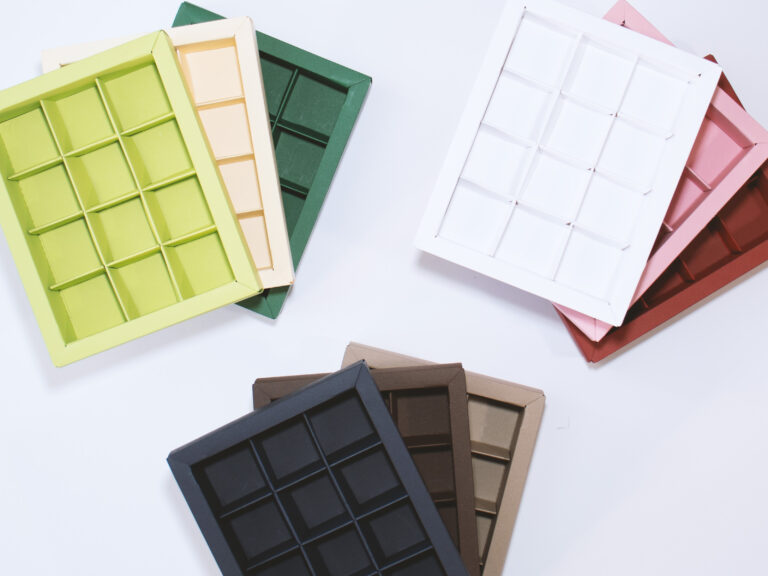
Our boxes are made mostly of fine board. Plastic parts separate by hand.
- Fine board, partly cast-coatedBoxes, lids, card dividersPaper recycling
- PVC clear lidseparates from the board by hand, without tools – so not composite packagingPlastic / lightweight packaging
- Gold-coloured PVC insert trayremovable by hand; alternative: card dividersPlastic / lightweight packaging
- OPP filmused as wrapping for some itemsPlastic / lightweight packaging
- Carrier bags and printed sleevesmostly paperPaper recycling
Our technical documentation covers the PFAS limit values and the heavy-metal limit (100 mg/kg). We are reviewing a change of lid material. We will state a recyclability performance grade as soon as the Commission has set the criteria.
Glossary A–Z
32 PPWR terms in brief. Search or pick a letter.
Authorised representative
A person established in the EU who has received a written mandate from a manufacturer to act on its behalf in relation to specified tasks (Art. 17). Not to be confused with the authorised representative for extended producer responsibility, which anyone delivering directly to end users in another EU country needs (Art. 45(3)).
Composite packaging
Packaging made of several materials that cannot be separated by hand (Art. 3(1)(24)).
Contact-sensitive packaging
Packaging for products such as food, cosmetics or medicinal products (Art. 3(1)(49)). Separate recycled content targets apply to it.
Distributor
Whoever makes packaging available in the supply chain without being the manufacturer or importer, for example a retailer (Art. 3(1)(18)).
E-commerce packaging
Transport packaging used to deliver products to end users through online or distance sales, such as the shipping carton (Art. 3(1)(8)).
Empty space ratio
Share of empty space in the total volume of grouped, transport or e-commerce packaging. Filling material counts as empty space (Art. 24).
EU declaration of conformity
Written declaration by the manufacturer that a packaging item meets the requirements of Art. 5 to 12. Content as set out in Annex VIII (Art. 39).
Extended producer responsibility (EPR)
The obligation of producers to finance the collection and recovery of their packaging. In Germany via system participation, in Austria via licensing.
Food contact material
Material that comes into contact with food. In addition to the PPWR, Regulation (EC) No 1935/2004 and, for plastics, Regulation (EU) No 10/2011 apply.
Grouped packaging
Packaging that groups several sales units, for example for the shelf or as a multipack (Art. 3(1)(6)).
LUCID
The packaging register of the Central Agency in Germany. Producers must register there before their first sale.
Making available on the market
Any supply of filled or unfilled packaging in the course of a commercial activity, whether in return for payment or free of charge (Art. 3(1)(9)).
Manufacturer
Whoever manufactures packaging or a packaged product, or has it manufactured under their own name. The manufacturer is responsible for conformity (Art. 3(1)(13)).
Microenterprise
A business with fewer than 10 employees and an annual turnover or balance sheet total of no more than €2 million (Recommendation 2003/361/EC). Certain special rules apply to it.
Module A (internal production control)
The procedure by which the manufacturer assesses and declares conformity itself (Annex VII). Third-party certification is not provided for.
Packaging minimisation
The weight and volume of packaging are to be reduced to the minimum necessary for its function. Mandatory from 2030 (Art. 10).
PFAS
Per- and polyfluoroalkyl substances. Since 12 August 2026, limit values have applied to food-contact packaging, for example 25 ppb for any individual PFAS (Art. 5(5)).
Placing on the market
The first making available of packaging on the EU market (Art. 3(1)(10)). According to the Commission’s guidelines, sales packaging is usually only considered placed on the market once it has been filled.
Producer
Whoever first makes packaging available in a Member State and finances its disposal there (Art. 3(1)(15)). Not to be confused with the company that physically produces the packaging.
Recyclability performance grades
From 2030, packaging must be recyclable. It is assessed in grades A, B and C. From 2038 only A and B are permitted (Art. 6).
Recycled content
Share of recycled plastic from post-consumer waste in the plastic parts of packaging. Minimum values apply from 2030 (Art. 7).
Reusable packaging
Packaging designed for multiple rotations that comes back via a reuse system (Art. 11).
Sales packaging
Packaging that, together with the product, forms a sales unit for the end user, for example the filled chocolate box on the shelf (Art. 3(1)(5)).
Service packaging
Packaging filled at the point of sale to hand over the product, for example a box filled at the counter or a carrier bag (Art. 3(1)(1)(d)).
Single-use packaging
Any packaging that is not reusable packaging (Art. 3(1)(28)).
Substances of concern
Substances that can harm health or the environment or impair recycling. Their presence in packaging is to be kept as low as possible (Art. 5).
Supplier
Whoever supplies packaging or packaging material to a manufacturer. The supplier must provide all documents needed to demonstrate conformity (Art. 3(1)(16), Art. 16).
System participation
In Germany, the contract with a dual system that organises collection and recovery. In Austria this is called licensing with a collection and recovery scheme.
Technical documentation
Documents with which the manufacturer demonstrates conformity: description, drawings, materials of the components, standards applied and test reports (Annex VII). Kept for five years for single-use packaging.
Transport packaging
Packaging that facilitates the handling and transport of sales units and prevents damage (Art. 3(1)(7)).
VerpackDG
The German Packaging Law Implementation Act. It supplements the PPWR in Germany and replaced the Packaging Act (VerpackG) on 12 August 2026.
Zentrale Stelle Verpackungsregister (ZSVR)
The German Central Agency Packaging Register, which runs the LUCID register and monitors producer obligations.
No term found.
Frequently asked questions
As a chocolatier, do I have to issue a declaration of conformity myself?
Yes, if you are the manufacturer. This is generally the case for filled sales packaging. You base your declaration on our declaration of conformity and our technical information. You must add anything that results from filling, such as labels or empty space. Keep both declarations for five years.
What has to be on the box now?
The name and postal address of the manufacturer as well as a type, batch or serial number (Art. 15(5) and (6)). The information can also be provided via a QR code or an accompanying document. The harmonised sorting label will come no earlier than 12 August 2028.
I have fewer than ten employees. What changes for me?
The special rule applies to microenterprises with fewer than 10 employees and an annual turnover or balance sheet total of no more than €2 million. If we produce packaging with your name or logo for you and your business is based in Germany, we are the manufacturer. For neutral boxes that you fill yourself, the legal position is not yet settled. Either way, you get the documents from us.
Can I still use boxes I bought before 12 August 2026?
Yes. The Commission is clear: packaging in stock does not have to be destroyed or relabelled. Name, address and identifier can be added later via an accompanying document. For conformity under Art. 5 to 12, what counts is when you place the filled box on the market.
Do the PFAS limit values apply to chocolate boxes?
Yes. Chocolate boxes are food-contact packaging. The limit values have applied since 12 August 2026. We take them into account in our technical documentation.
Will PVC clear lids be banned in future?
The PPWR does not expressly ban PVC in packaging. From 2030, however, requirements for recyclability and recycled content apply, which also affect plastic parts. We are reviewing a change of lid material.
Do I have to register in the LUCID packaging register?
If you are the first to make filled sales packaging available in Germany, you are the producer and must be registered. This was already the case under the Packaging Act. Check your details in LUCID – the PPWR has redefined the roles.
Will you handle system participation for me?
For neutral service packaging from our range, we take care of system participation in Germany. For sales packaging that you fill and put on the shelf, you have to participate yourself – we cannot take this obligation off your hands.
How much air can there be in a chocolate box?
There is no fixed percentage limit for sales packaging. Empty space must be limited to what is necessary for the function and protection of the chocolates. The 50 per cent limit only applies from 2030 and only to grouped, transport and e-commerce packaging.
What applies to bespoke packaging with my logo?
You get a separate declaration of conformity under the HF-DoC-SA scheme. If the packaging bears your name or logo, you are the manufacturer. Exception: you are a microenterprise based in Germany. Then we are the manufacturer.
Do I need the documents if I only sell in Switzerland?
The PPWR does not apply to sales in Switzerland. As soon as you deliver chocolates to the EU, you or your importer need the evidence. We provide the documents on request.
Is there a PPWR certificate for your packaging?
No. The PPWR does not provide for certification of packaging. The manufacturer assesses conformity itself under Module A and declares it in writing. Our packaging is PPWR-compliant, and we demonstrate this with our declaration of conformity.
Request the declaration of conformity
Business customers can download the declaration of conformity for the standard range after logging in – always the current version.
- 1Log in or register
with your customer account
- 2Activation
automatically after your first order, otherwise on request
- 3Download
PDF, HF-DoC-2026-01
For bespoke packaging you get a separate declaration with the order confirmation. Questions about a product? Get in touch.
The download is available to logged-in business customers.